
General information about US federal tax, not tax advice. Rules change and individual circumstances differ. Confirm anything here with a qualified accountant or the IRS before relying on it.
What a 1099 actually is
A 1099 belongs to a family of IRS forms called information returns. A business or platform that pays you files one with the IRS and sends you a copy, so the IRS knows about the income before you report it. Employees get a W-2 for the same purpose. Anyone paid as a non-employee gets a 1099 instead.
There are more than a dozen versions. Two matter to almost every freelancer:
- 1099-NEC, for nonemployee compensation. Sent by a client that paid you directly for your services, by bank transfer, ACH or cheque. This is the form people usually mean when they say "a 1099".
- 1099-K, for payment card and third-party network payments. Sent by a payment platform such as PayPal or Stripe, or by a freelance marketplace, when it processed your payments.
You may also see a 1099-MISC, used for rent, prizes and a few other payments, or a 1099-INT for interest on a business savings account. Neither changes anything below.
1099 vs W-2: what the difference costs you
The form follows from the working relationship. A W-2 means you are an employee: your employer withholds income tax from every paycheck, pays half of your Social Security and Medicare tax, and may owe you overtime, benefits and unemployment insurance. A 1099 means the payer treats you as an independent contractor running your own business. Nothing is withheld, and every one of those costs becomes yours.
| W-2 employee | 1099 contractor | |
|---|---|---|
| Income tax | Withheld from every paycheck | Nothing withheld; you pay through estimated payments |
| Social Security and Medicare | 7.65 percent, with the employer paying another 7.65 | 15.3 percent, both halves, on 92.35 percent of net profit |
| Business expenses | Generally not deductible | Deducted from income on Schedule C |
| Benefits, overtime, unemployment | Often included | None, unless you fund them |
| Control over the work | The employer's | Yours |
| Year-end form | W-2 | 1099-NEC or 1099-K |
Plenty of people search for "1099 employee", but the phrase contradicts itself. An employee should get a W-2. A 1099 is the payer saying you are not an employee. Whether the payer is right depends on how much control it has over how, when and where you work, not on which form it chooses to send. If you believe you have been misclassified, the recipient instructions on the 1099-NEC point to Form 8919, which in qualifying situations lets you report the pay as wages and pay only the employee share of Social Security and Medicare. IRS Publication 1779 sets out the tests.
The same gap is why a contractor rate should never be compared with a salary divided by 2,080 hours. The freelance vs full-time calculator shows the difference in dollars.
The big 2026 change: the $2,000 threshold
Until the end of 2025, a client had to send you a 1099-NEC once it had paid you $600 or more in the year. The One Big Beautiful Bill Act, signed in July 2025, raised that threshold to $2,000 for payments made after 31 December 2025. The same $2,000 applies to Form 1099-MISC. From 2027 the figure is indexed to inflation and rounded to the nearest $100; the IRS had not published the 2027 amount at the time of writing.
The timing trips people up. The forms that arrived in January 2026 still used the old $600 rule, because they covered 2025. The first forms under the new rule arrive in January 2027, and they cover the work you are doing now.
In practice many freelancers will receive fewer forms. A client that paid you $1,500 across 2026 no longer has to send anything. That income is still taxable, which is the trap covered in the next section.
The 1099-K threshold went back up too
The 1099-K had been on its way down to $600 as well. The same law cancelled that and restored the original rule: a payment platform only has to send a 1099-K when your payments for goods or services exceed $20,000 and 200 transactions in the year, and both conditions must be met.
Two exceptions are worth knowing. Payments taken directly by card through a card processor have no threshold at all. And several states, including Maryland, Massachusetts, Vermont and Virginia, have used a $600 threshold for their own reporting, so a platform may still send you a 1099-K for far less than $20,000.
The 1099-NEC itself has been redesigned
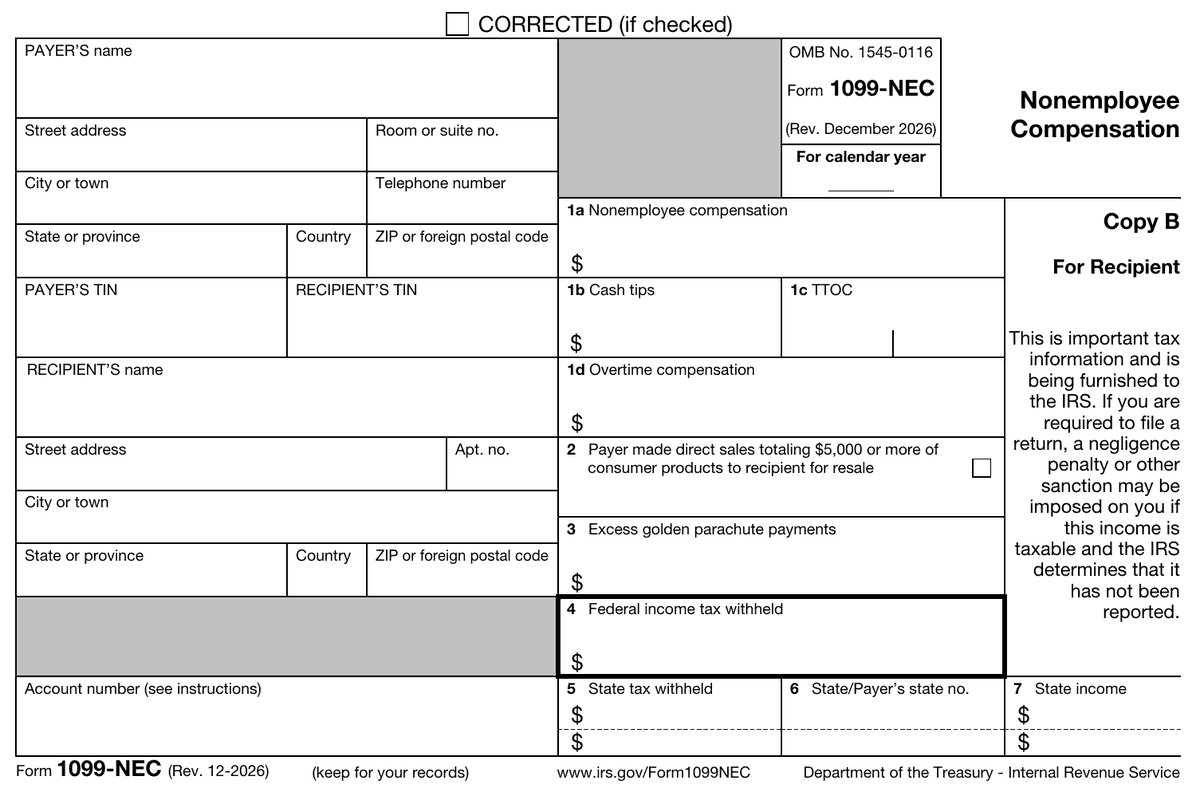
The version of the 1099-NEC the IRS has published for reporting 2026 payments, dated December 2026, splits the old box 1 into four:
- Box 1a, nonemployee compensation. The total you were paid. For most freelancers this is the only number that matters.
- Box 1b, cash tips, and box 1c, TTOC. Tips and a Treasury Tipped Occupation Code, used to claim the new deduction for qualified tips.
- Box 1d, overtime compensation. Used to claim the new deduction for qualified overtime pay.
Amounts in boxes 1b and 1d are already included in box 1a, so do not add them a second time. If you are a designer, developer or writer paid a project fee, expect 1b to 1d to be blank.
No 1099? You still owe the tax
This is the most common question about 1099s, and the higher threshold does not change the answer. The IRS says taxpayers must report all income "regardless of whether they receive a Form 1099-K or other information return."
The form is a cross-check, not a bill. Clients report what they paid you, and the IRS matches those reports against your return. A missing form means one fewer cross-check, not one fewer dollar of income. The matching also works the other way: if a client filed a 1099 that never reached you, the IRS still has its copy.
The fix is to stop using forms as your income record. Keep your own list of every paid invoice, reconcile it against your business bank account once a month, and treat any 1099s that arrive as a check on that list rather than as the list itself.
1099-NEC or 1099-K: it depends how you were paid
Which form you get depends on the payment route, not on the work.
- Paid by bank transfer, ACH or cheque. The client is responsible for the 1099-NEC, if it paid you $2,000 or more in 2026.
- Paid by credit card, PayPal, Stripe or through a marketplace. The payment is reported, if at all, by the platform on a 1099-K. The IRS instructions say payments made this way are not reported on a 1099-NEC, so the client should not send one as well.
Mistakes still happen, most often when a client pays through a platform and sends a 1099-NEC anyway, so the same money appears on two forms. Report the income once, keep the records that show both forms describe the same payments, and ask the client for a corrected form. The mechanics of handling a duplicate on your return are worth a quick question to your accountant.
The W-9 comes first
Before a client can send you a 1099, it needs your taxpayer identification number. That is what Form W-9 is for. New clients usually send one with their onboarding paperwork, and filling it in is routine. The current version is still the March 2024 revision; there is no separate 2026 W-9.
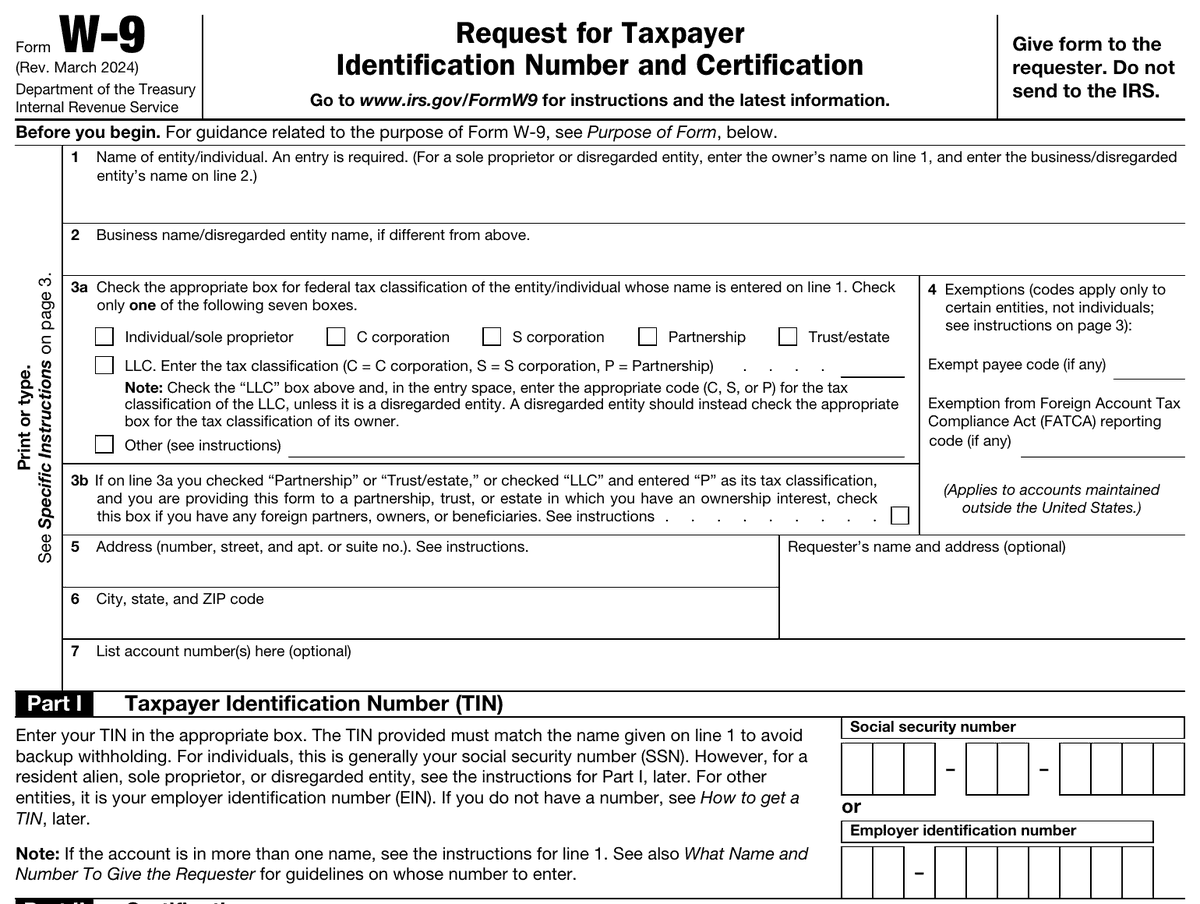
- Give it to the client, not the IRS. The form says so in its top corner.
- Use an EIN instead of your Social Security number if you can. An employer identification number is free from the IRS, takes minutes to get online, and keeps your SSN out of a dozen clients' inboxes.
- Send it through something more secure than plain email where you have the choice. It holds the number identity thieves want most.
- Do not ignore the request. A payer that cannot get your number may have to apply backup withholding at 24 percent to what it pays you.
How 1099 income is taxed
1099 income carries two separate taxes, and the first one is the one that surprises people.
Self-employment tax is Social Security and Medicare for people who work for themselves. It is 15.3 percent: 12.4 percent for Social Security and 2.9 percent for Medicare, charged on 92.35 percent of your net profit once your net earnings reach $400 for the year. The Social Security part stops at $184,500 of combined earnings in 2026. The Medicare part has no cap, and an extra 0.9 percent applies above $200,000 for a single filer.
Income tax is charged on the same profit at your normal bracket, after deductions. Half of your self-employment tax is deductible here, and many freelancers can also deduct up to 20 percent of their qualified business income, a deduction the 2025 law made permanent. Both reduce income tax only, not self-employment tax.
Here is what self-employment tax alone comes to at a few levels of profit, next to what an employee would pay on a salary of the same size.
| Net profit | Self-employment tax | Employee equivalent |
|---|---|---|
| $30,000 | $4,239 | $2,295 |
| $50,000 | $7,065 | $3,825 |
| $80,000 | $11,304 | $6,120 |
| $120,000 | $16,955 | $9,180 |
Income tax comes on top. That is why the usual advice is to move 25 to 30 percent of every 1099 payment into a separate account the day it clears, and more in a high-tax state. The guide to quarterly estimated taxes covers the system, and the quarterly tax calculator works out a figure from your own income and state.
How to file taxes with a 1099, step by step
- Gather every 1099 and your own income records. Reconcile the forms against your list of paid invoices. Your list is the source of truth, and it includes the clients who sent nothing.
- Total your business expenses. Software, equipment, a share of phone and internet, payment fees, insurance, accountancy. Tax is charged on profit, so every recorded expense lowers both taxes. The business expense guide covers what people miss.
- Complete Schedule C. All business income goes at the top, whether or not a 1099 reported it; expenses go below; the result is your net profit.
- Complete Schedule SE to turn that profit into self-employment tax.
- Carry both onto Form 1040, along with the estimated payments you made during the year.
- Pay any balance by the filing deadline, and make the first estimated payment for the new year on the same day.
One exception: if a payment really was a one-off rather than part of a business, such as income from a hobby or a sporadic activity, the form's own instructions say to report it as other income on Schedule 1 instead, without self-employment tax. Most freelancers are running a business, and the IRS will generally see it that way too.
Key dates for the 2026 tax year
| Date | What happens |
|---|---|
| 15 January 2027 | Fourth and final estimated tax payment for 2026 |
| 1 February 2027 | Deadline for clients to send you a 1099-NEC, and for platforms to send a 1099-K, for 2026. The usual 31 January date falls on a Sunday. |
| 15 April 2027 | Federal return and any balance due for 2026; first estimated payment for 2027 |
The third 2026 estimated payment was due on 15 September. If you missed it, paying now reduces the penalty, which is charged much like interest for as long as the payment is late.
What to do if a 1099 is wrong or missing
- It has not arrived. If a client that paid you $2,000 or more has sent nothing by mid-February, ask for it. Do not wait on it to file, though: report the income from your own records.
- The amount is wrong. Ask the payer for a corrected form; the 1099 has a "corrected" box for exactly this. Common causes are a payment counted in the wrong year and money paid through a platform being included twice.
- Your name or number is wrong. Ask for a correction promptly. A mismatch between the name and number the IRS holds can lead to backup withholding notices later.
- You believe you should have had a W-2. See the note on misclassification in the 1099 vs W-2 section, and talk to an accountant before you file.
What this means for what you charge
Almost every figure in this guide is a cost an employer would otherwise carry. The employer half of payroll tax, unpaid holidays, health insurance and retirement contributions all move to your side of the ledger the moment you are paid on a 1099. A rate that matches a salary divided by 2,080 hours leaves you worse off than an employee doing the same job.
The rate calculator works backwards from the income you want, through self-employment tax, expenses and realistic billable hours, to the rate you actually need to charge.